Cart
0
Table of Contents
- What to Look For in Coffee Beans for Home Brewing
- How to Choose Coffee Beans for Your Brew Method
- Coffee Beans for Espresso: Our Picks
- Coffee Beans for Cafetière: Our Picks
- Coffee Beans for Filter: Our Picks
- Microlots and Decaf: Where Home Brewers Find Something Different
- How We Chose These Coffees
- Where to Start
- Frequently Asked Questions
Last updated: 14 October 2026
What to Look For in Coffee Beans for Home Brewing
Good coffee beans for home brewing are fresh, traceable and suited to the way you brew. Of the three, freshness makes the biggest difference. Beans roasted in the last few weeks taste livelier and sweeter than beans that have sat in a warehouse or on a shelf for months.
We roast in small batches by hand at Hursley Park, just outside Winchester, so your beans reach you close to their roast date. That one thing changes what you taste in the cup more than any new gadget.
It's easy to miss, because most bags lead with a best-before date. What you actually want to know is when the beans were roasted, and how they've been stored since.
Key Takeaway Freshness is the one thing you can check before you buy. Look for a roast date on the bag, not just a best-before date. A best-before tells you when the coffee is safe to drink; a roast date tells you when it will taste its best.
Below, we explain how to match beans to your brew method, then share the coffees we'd reach for at home for espresso, cafetière and filter.
How to Choose Coffee Beans for Your Brew Method
Start with your kit, not your taste preferences. Each brewer pulls flavour out of the coffee differently (that's what we mean by extraction), and the wrong roast for your setup can taste flat or bitter however good the beans are.
Here's how we think about it:
Brew Method |
Roast Level |
Grind Size |
What to Look For |
|---|---|---|---|
Espresso |
Medium to medium-dark |
Fine |
Chocolate and caramel notes, low acidity |
Cafetière |
Medium |
Coarse |
Smooth body, balanced sweetness |
Filter |
Medium to light |
Medium |
Bright acidity, fruit and floral notes |
AeroPress or V60 |
Light to medium |
Medium-fine |
Complexity, clarity, sweetness |
A common mistake is buying one bag for every method. Espresso needs beans that hold up under pressure. Filter suits lighter roasts, which can taste thin and sharp through an espresso machine.
Pro Tip If you brew more than one way, buy two bags rather than compromising on one. The cost difference is small, and you'll notice it in every cup.

Coffee Beans for Espresso: Our Picks
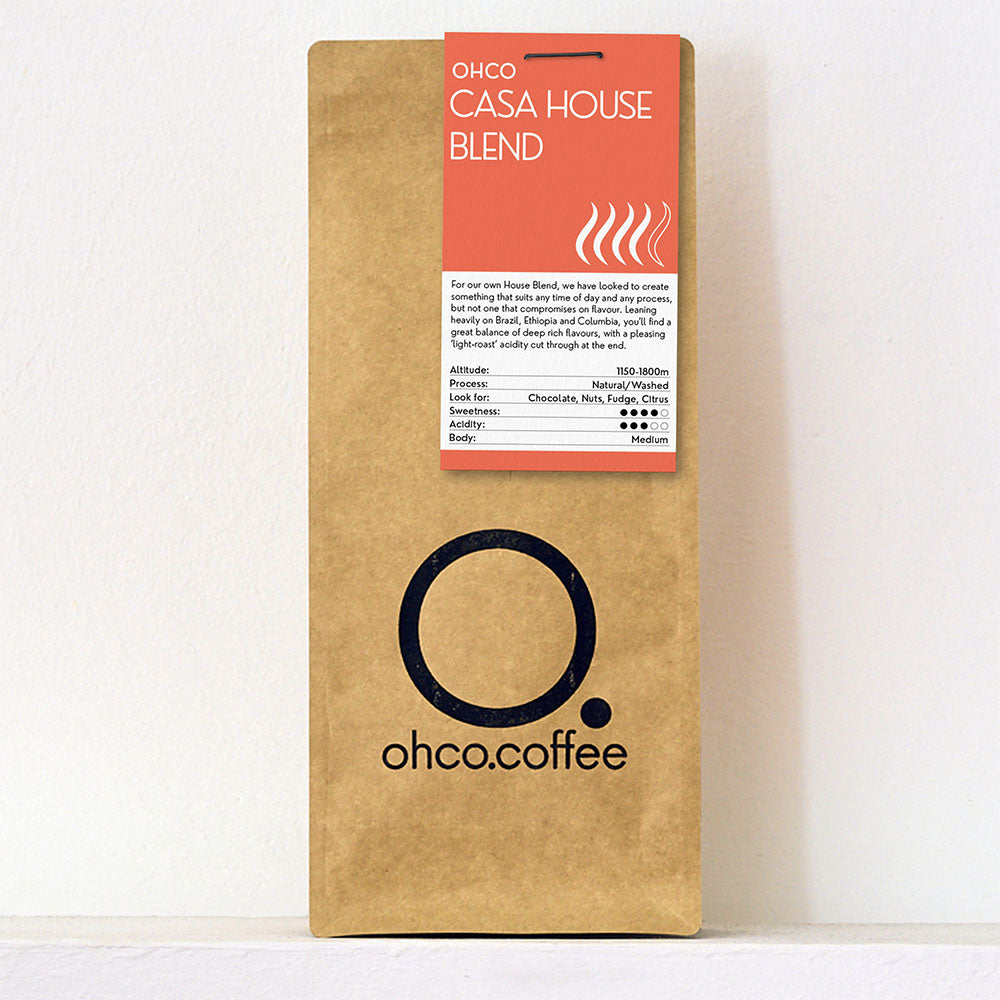
For espresso, look for medium to medium-dark roasts with chocolate or caramel character and enough body to cut through milk. Our pick is Casa OHCO House Blend, a blend of beans from Brazil, Ethiopia and Colombia. It has deep chocolate notes and a clean, bright finish, and it works just as well in a filter or cafetière.

Casa OHCO House Blend
For a single origin, Colombia Excelso is smooth and complex, and it comes into its own in a flat white, where the chocolate tones come forward. A hint of acidity gives it a clean, crisp finish. It's grown by members of the ASOBRIS producer association in Planadas, which is Fairtrade and Organic certified and reaches 25 villages.
Pros:
- Both hold up well under espresso pressure
- Chocolate-led profiles suit milk drinks
- Roasted in small batches, so they reach you fresh
Cons:
- If you prefer lighter roasts, these may taste too rich
- Single bags are £10.00 each, so buying several adds up
Good For Home baristas who drink flat whites and cortados, and anyone who wants one bag that also works in a filter or cafetière.
Coffee Beans for Cafetière: Our Picks
For a cafetière, medium roasts with a smooth body and balanced sweetness work well, ground coarse to keep sediment out of your cup. Brasilia Fazenda Dutra Organic fits the brief: a smooth, nutty cup with a touch of eucalyptus, from a family-run farm in São João do Manhuaçu that has grown coffee since the 1950s.
If you like something brighter, Nicaragua Fincas Mierisch Laguna Verde has a striking sweetness and lively acidity. Fog covers the trees for more than half the day during harvest, which slows the cherries' ripening and concentrates the flavour.
Cafetière brewing rewards a little patience. Let the coffee steep for four minutes before you press, and use a coarse grind so the mesh filter doesn't clog.
Coffee Beans for Filter: Our Picks
For filter, medium to light roasts with bright acidity and fruity notes are the ones to try. Ethiopia Guji Hambella is our go-to: a naturally processed coffee (the cherries are dried whole, fruit and all) from Abebe Mitiku's four-hectare farm in the East Guji zone, scoring 87 points. Expect strawberry, tropical fruit and florals in a sweet, lifted cup.

Ethiopia Guji Hambella
Kenya Rung'eto Kiangoi AA has a different character: lively acidity balanced by caramel sweetness, so it never tastes too sharp. We like it black from an AeroPress or V60. The Rung'eto Farmers' Co-operative Society works with 1,150 coffee farmers and uses its Fairtrade premiums to fund community projects.
Both coffees like a medium grind and a slow pour. Filter is where lighter roasts really show what they can do.
Microlots and Decaf: Where Home Brewers Find Something Different
Microlots and decaf are where you'll find coffees you rarely see on a supermarket shelf. A microlot is a small batch from a single farm or plot, processed separately, often with longer fermentation or drying to build unusual flavours. Our Ceiba Honey Colombia Innovation Microlot has a 36-hour anaerobic (oxygen-free) pre-fermentation and then a 120-hour fermentation, which brings out caramel, citrus and raspberry notes.
Tropical Chiroso Innovation Microlot takes a different route: a 48-hour fermentation and a long drying time give a surprisingly sweet cup, full of flowers and fruit. Both microlots are £11.95.
Decaf doesn't have to be a compromise. Mexico Mountain Water Decaf uses pure water from Pico de Orizaba to remove the caffeine without stripping out the flavour. It's warm and complex, with a little wine and citrus at the finish.

Mexico Mountain Water Decaf
The OHCO Coffee Club saves you 15% on every bag, with free UK delivery on orders over £25 and no minimum term. You can pause, skip or cancel at any time.
How We Chose These Coffees
We picked these coffees on four things: freshness, traceability, how well they suit each brew method, and value. Every bag in our range is hand-roasted in small batches in Hampshire, so it reaches you close to its roast date.
Traceability mattered as much as taste. We only buy beans where we can name the producer or co-operative, whether that's Abebe Mitiku in Ethiopia or the ASOBRIS association in Colombia.
Value came last. A cheap bag is only good value if it tastes good. Most of our single-origin bags are £10, and the Coffee Club takes 15% off every one.
Watch Out Buying coffee by best-before date alone is the mistake we see most often. A bag can be months past its best drinking window and still be "in date". Always look for a roast date.
Where to Start
Choosing coffee for home comes down to two things: matching the roast to your brewer and buying it fresh. Get those right and your coffee will improve before you change a single piece of kit.
If you're not sure where to begin, try a bag of Casa OHCO House Blend. It's an all-day coffee that works for espresso, filter and cafetière. Once you know what you like, try one of our single origins or microlots. If you get through a bag every week or two, the OHCO Coffee Club gives you 15% off every bag, free UK delivery over £25, and the freedom to pause or cancel whenever you like.
Frequently Asked Questions
What are the best coffee beans for brewing at home?
It depends on how you brew. For espresso, try Casa OHCO House Blend (£10), a Brazil, Ethiopia and Colombia blend with chocolate notes and a clean finish. For cafetière, Brasilia Fazenda Dutra Organic (£10) gives a smooth, nutty cup with a touch of eucalyptus. For filter, Ethiopia Guji Hambella (£10) has strawberry, tropical fruit and floral notes. All are hand-roasted in small batches in Hampshire, so they arrive fresh rather than after months on a shelf.
Which coffee beans are best for a cafetière?
Medium roasts suit the cafetière because the coffee steeps fully in the water and extracts evenly without turning bitter. Brasilia Fazenda Dutra Organic (£10) is a good place to start: smooth and nutty with a touch of eucalyptus, from a family-run farm that has grown coffee since the 1950s. Use a coarse grind, roughly the texture of sea salt, and a four-minute steep. Buy whole beans and grind just before brewing if you can.
What coffee beans should I use for espresso at home?
Espresso suits blends and slightly darker roasts that stand up to pressure and give a thick crema. Casa OHCO House Blend (£10) works for espresso, filter or cafetière, with deep chocolate notes and a bright finish. If you prefer a single origin, Colombia Excelso (£10) is smooth and complex, with chocolate tones that come through in a flat white. Use a fine grind and aim for a 25 to 30 second shot.
Are light or dark roast beans better for home brewing?
Neither is better overall. It depends on your taste and your brewer. Light roasts, like Ethiopia Guji Hambella (£10) with its strawberry and floral notes, suit filter and pour-over because they keep their acidity. Medium roasts, like Casa OHCO House Blend (£10) with its chocolate notes, work across espresso, filter and cafetière. Darker roasts taste bolder and are more forgiving if your grinder or timing is a little inconsistent.
How fresh should coffee beans be for home brewing?
Aim to brew your beans within two to four weeks of the roast date. After that, the flavours fade and the coffee starts to taste flat. We roast in small batches in Hampshire, so your beans arrive close to their roast date rather than months later. Keep them in an airtight container away from light and heat, and grind only what you need for each brew.